
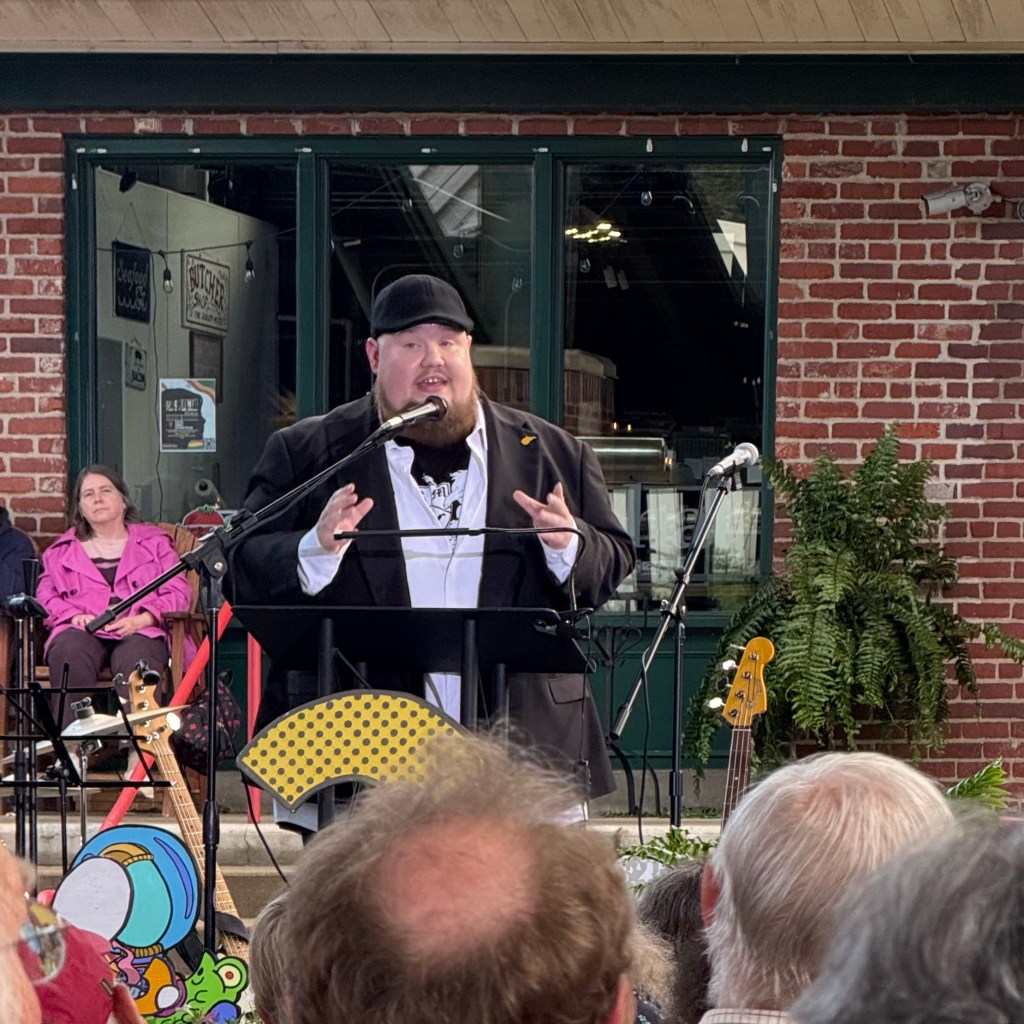
Recently Jason Young spoke in Charleston as part of FestivALL’s “Three Things” series. This live series—now in its 10th season—asks its three participants to speak about their first, favorite, and future. The interpretation of these instructions, though, is left up to each participant.
The Three Things series, created and directed by Jeff Shirley, is an exclusively live and in person experience. The following, however, is the transcript of his speech. We hope you’ll find it moving and motivating. On this particular night on May 28th, Jason shared the stage with Nellita Sanchez, known as Charleston’s “Empanada Lady,” and the wonderfully eccentric and multi-talented Ann Magnuson. It was a sold out show. They had to add full rows of extra seating to accommodate everyone.
And Crispin Crispian shall ne’er go by,
From this day to the ending of the world,
But we in it shall be remember’d;
We few, we happy few, we band of brothers;
For he to-day that sheds his blood with me
Shall be my brother; be he ne’er so vile,
This day shall gentle his condition:
And gentlemen in England now a-bed
Shall think themselves accursed they were not here,
And hold their manhoods cheap whiles any speaks
That fought with us upon Saint Crispin’s day.
Those are the words I first heard spoken… by Danny DeVito in the 1994 quirky, coming-of-age comedy, THE RENAISSANCE MAN.
Jim Burnstein penned the screenplay for the film that Penny Marshall directed (no relation to our native son Peter Marshall). But these words that resonated so with me belonged to William Shakespeare.
I was probably15 when I first saw this film, which means it was just shy of 30-years ago. The monologue, commonly referred to as the St. Crispin’s Day speech comes from HENRY V, a play which Shakespeare wrote circa 1599.
After seeing the film, I asked my mom to take me to the bookstore at the mall…back when we had malls…with bookstores…and I purchased the play…well, my mom purchased the play…I didn’t read it. Instead, I sat on the corner of my bed and quickly skimmed through the pages until I found the speech in Act IV, scene iii.
This scene takes place on the eve of the historic Battle of Agincourt, between the French and English, where King Henry, knowing his army is outnumbered, delivers these powerful words to boost the English army’s morale. The speech inspires the soldiers and makes them believe they can achieve victory, even in the face of overwhelming odds.
I was inspired.
From the corner of my bed, I read the speech silently. I read the speech aloud, mispronouncing words like Exeter, Warwick, and Gloucester. I stood so I could perform the speech…clumsily, passionately, and oh so dramatically. Confident that I was by far the best pubescent classical actor in my zip code, and that one day, if my NBA playing career didn’t work out, I could be speaking this speech in a Jim Burstein written and Penny Marshall directed quirky, coming-of-age comedy.
As I matriculated from middle school to high school, I immediately encountered “curricular Shakespeare.” I went to public school in West Virginia, and I have vivid memories of sitting in the uncomfortable wooden desks at Bridgeport High School and studying ROMEO & JULIET as a freshman, JULIUS CAESAR as a sophomore, and MACBETH my senior year.
With each new encounter my appetite for the language increased. And each new play provided me a new opportunity to stand in front of my bathroom mirror and sharpen my acting skills.
But soft, what light through yonder window breaks?
It is the East, and Juliet is the sun.
Arise, fair sun, and kill the envious moon,
Who is already sick and pale with grief
That thou, her maid, art far more fair than she.
Friends, Romans, countrymen, lend me your ears;
I come to bury Caesar, not to praise him.
The evil that men do lives after them;
The good is oft interred with their bones;
So let it be with Caesar.
Is this a dagger which I see before me,
The handle toward my hand? Come, let me clutch thee.
I have thee not, and yet I see thee still.
Art thou not, fatal vision, sensible
To feeling as to sight? or art thou but
A dagger of the mind, a false creation,
Proceeding from the heat-oppressed brain?
I became heat-oppressed with a desire to see as much Shakespeare as I could. I wanted to hear the language out loud and see the plays being performed.
Reading Shakespeare is never enough. It will scratch your itch in a pinch, but receiving the full experience of a Shakespeare play by reading it is like enjoying a song by staring at the sheet music.
I started going to plays, any performance of Shakespeare that I could access based upon my age and current location. I encountered two problems very quickly – 1) there wasn’t very much Shakespeare being performed in West Virginia and – 2) what I could find, wasn’t very good.
So, I lost my appetite, I put my hunger and quest for Shakespeare on the back burner. In fact, I decided that maybe I was wrong about this particular playwright and how much I loved him…maybe it was just a phase, like when I used to eat cheddar cheese cubes on top of Oreo cookies as an after school snack in elementary school, or the summer I pretended to be a new recruit in He-Man’s army, or the way I was once convinced that slap bracelets defined my fashion sense.
I still enjoyed going to live theatre. I hung on to that, thankfully, so I kept going to see shows, and eventually was bitten by the musical theatre bug when I was in high school, so much so that I decided to major in theatre at Fairmont State University, and that is where I encountered the American Shakespeare Center and their performance style, it reminded me of what I had loved and forgotten about this amazing playwright.
It was around 2004… a mere ten years after THE RENAISSANCE MAN was released…and at the time the American Shakespeare Center was touring three shows in true rotating repertory. Fairmont State brought them to campus for a week-long residency for at least three years while I was a student. The touring troupe from the ASC performed for high school students that we brought to campus in the mornings, taught workshops in place of our normal theatre classes throughout the day, and in the evenings towards the end of the week performed three different shows on three consecutive nights.
During those multiple visits I saw A MIDSUMMER NIGHT’S DREAM, JULIUS CAESAR, MUCH ADO ABOUT NOTHING, RICHARD III, THE MERCHANT OF VENICE, THE TAMING OF THE SHREW and productions of non-Shakespeare penned plays like CYRANO DE BERGERAC and RETURN TO THE FORBIDDEN PLANET, Shakespeare’s lost rock masterpiece.
It was the most Shakespeare I had ever seen. It was also the best Shakespeare I had ever seen.
The American Shakespeare Center is the troupe that coined the phrase “Shakespeare’s Staging Conditions,” and famously claimed, “we do it with the lights on.” Through research and scholarship they learned that Shakespeare’s plays were mostly performed during the daylight hours, illuminated by sunlight, whether that be through the open roof of the famous Globe or the large beautiful windows of the indoor playhouses of the day.
When Shakespeare’s plays were performed inside, the theatre was illuminated by candles that hung from giant chandeliers. So, they had very little to no control of the light. They couldn’t put the audience in the dark and keep the actors in the light. We called this “shared light.”
Shakespeare’s audience could see the actors, the actors could see the audience, and most importantly the audience could see each other. The lighting style allowed Shakespeare to write all of the direct address, audience interaction, and what we call “casting of the audience,” into his scripts.
You take those two staging conditions and add in modern music and modern costumes…because Shakespeare used music and costumes that were modern to his audience, so the ASC used music and costumes modern to theirs…and you have the ingredients for a style of Shakespeare that was mind-blowingly original, and yet quite historic, and electrifyingly engaging, and…in my case…life changing.
I now had a new hunger, a new craving, not only was I re-inspired to want to perform Shakespeare, I wanted to perform Shakespeare like the ASC. I wanted to stand center stage and look an audience member directly in the eye, and have that audience member look right back at me so I could tell them as Dogberry from MUCH ADO ABOUT NOTHING is want to do, “I am an ASS.”
My wife, Sarah Young and I, opened The Vintage Theatre Company in 2011, in 2012 our first performance troupe debuted, The Fearless Fools, an improv and sketch comedy troupe. Then, in 2013 we founded The Rustic Mechanicals. The only professional Shakespeare troupe in West Virginia. We started the troupe because at the time West Virginia didn’t have a Shakespeare troupe, and while I didn’t know anything about running a Shakespeare troupe, I knew that I wanted people like me, fans of Danny Devito films, who felt like they weren’t getting their Shakespeare needs fulfilled, to have the same type of access and experience that the American Shakespeare Center gave me when I was in college.
We jumped in the river and began building the boat on our way downstream. We just started producing plays and taking them to as many communities as would have us. Our first production was A MIDSUMMER NIGHT’S DREAM, we had seven actors, and we played four different amphitheaters in north central West Virginia. It was a very long tour that weekend.
Over the next several years, we kept producing shows, trying our best to create a communal Shakespeare experience without the knowledge or the tools on exactly how to do it. Just like my middle school self on the corner of my bed trying to inspire the English troops in the best and only ways I knew how at the time.
We kept gaining momentum, more artists joined our ranks, and more venues gave us a chance. And that is when I met Jim Warren.
In 1988…less than ten years before THE RENAISSANCE MAN was released…Jim, then a recent graduate from James Madison University, and Dr. Ralph Alan Cohen, a professor at the same institution, founded the Shenandoah Shakespeare Express, a troupe that went on to become the American Shakespeare Center, and built the Blackfriars Playhouse in Staunton, VA.
After 30-years navigating this monumental arts institution, Jim retired from the ASC and began exploring new opportunities. He was serving Davis & Elkins College as a visiting professor when we were introduced. We connected immediately, and in addition to becoming a great friend, he also became my mentor. He agreed to spend a few months in Clarksburg directing the Rustic Mechanicals, those few months have turned into countless visits over six years, and those visits have resulted in productions of AS YOU LIKE IT, A MIDSUMMER NIGHT’S DREAM, MUCH ADO ABOUT NOTHING, TITUS ANDRONICUS, LOVE’S LABOUR’S LOST, CYMBELINE, ROMEO & JULIET, RICHARD II, HENRY IV, PART ONE, OTHELLO, HAMLET, JULIUS CAESAR, THE TEMPEST, HENRY IV, PART TWO, and our current touring production of MACBETH.
He brought us Shakespeare’s Staging Conditions. He helped us learn to do it with the lights on and blend the Elizabethan with the modern, and every era in between, to take our Appalachian audiences back to the future with every performance and in collaboration and community create, what we call, a Shakespeareance.
We chat with audiences, especially students after every performance, and we regularly get this question: What is your favorite Shakespeare play? My answer is always whichever play I am working on at the time. Truly, I love them all, but more than anything for me, even in some ways more than the plays themselves, my favorite is our style and how many people we get to share it with.
Our Shakespeare is immediate and it is ephemeral. Every Shakespeareance is a once in a lifetime opportunity. And for so many in West Virginia and Appalachia we have had the honor of giving them their first Shakespeareance. At each performance we ask the audience how many are experiencing live Shakespeare for the first time.
It’s a humbling thought to know that when we perform with students and adults who are experiencing a story live for the very first time, I forever become the Macbeth they see in their minds’ eyes whenever they think about the play. The same way that when I say Rocky Balboa you see Sylvester Stallone, and when I say Princess Leia you see Carrie Fisher, and when I say James Bond you see Sean Connery, and if you don’t, you’re wrong.
Over the years we’ve developed some fans, maybe even a few fanatics. Jerry Smith lives in Nashville, Tennessee. He claims to be the only person in Tennessee that has a Rustic Mechanicals sticker on his car. Jerry has family here in West Virginia and each year he plans his annual visit to the Mountain State around when we are performing near his family. He comes to see every production. Two years ago we toured HAMLET. Last year it was JULIUS CAESAR. Stephen Phillips, a troupe member, performed in both shows. After a performance of CAESAR, Jerry from Nashville walked up to Stephen and Stephen attempted to introduce himself. Jerry stopped him and said “we met last year.” Stephen was quite confident he had never met Jerry before, so he said, “Oh, I am sorry, I didn’t remember.” Jerry went on to explain to him that they had never chatted after a show like this, but that during a performance of HAMLET with Jerry on the front row, Stephen, as LAERTES, laying on the floor, dying, having been cut by his own poisoned tipped foil, looked Jerry right in the eyes and said “I am justly killed by my own treachery.” And that moment, that sentence, that connection landed so firmly and personally with Jerry that a year later he described it as “meeting” Stephen.
That is the power of a Shakespeareance. That is what Jim gave us and that is what we are giving to Appalachia.
A lot has changed in my world recently, a lot has changed in our world. With the chaos and turmoil that continues to swell and rumble from our state house all the way to the nation’s capital through the Kennedy Center, the NEA, the NEH, AmericaCorps, and Harvard University…artists, creatives, and educators have been given pause. We’ve had artists’ lives changed so much that they have taken leave from our troupe, we’ve had venues cancel our bookings, and we’ve allowed fear and uncertainty to creep into our everyday thinking. And when times like these come and everything seems harder than it should be, the fatigue and the doubt set in much more quickly.
I feel like I am coming into my prime as an artist, my background in improv and music has always made me feel like I was groomed for our style of Shakespeare. The on-the-job training I have received over the last six years helps me to continue to step into my power as a performer. But even at my best, I still always feel humbled and a little jealous of the effortless talent that is on display anytime my wife Sarah steps on stage. I also feel like the work we do, being so community and collaboratively centric, may be more important now than it has ever been.
But even with all that certainty, I still don’t know what the future will be.
I do know, however, who the future will be. It will be Sarah and I, and Jim, producing plays with great West Virginia artists, and taking those plays to any community in Appalachia that will have us. It will be our troupe leaders like John Shirley, our Director of Education, and Derek Hess, our Associate Artistic Director, who are most responsible for all of the work we do with students. It will be Isaiah Canterbury, a hungry, and talented young man who just graduated from Capital High School in Charleston, who we helped coach to a championship winning performance at the 2025 English Speaking Union’s National Shakespeare Competition. And…ultimately…our future will be you, the fellow art makers, art supporters, and educators in West Virginia who are left with no other choice but to step up, stand in the gap, and reinvest in those things we hold most dear and believe are important for ourselves, our communities, and our collective future.
Even though this moment is tense, scary, uncertain, and at times I know we feel totally outnumbered, I truly believe that one day…
This story shall the good man teach his son;
And Crispin Crispian shall ne’er go by,
From this day to the ending of the world,
But we in it shall be remember’d;
We few, we happy few, we band of brothers;
For he to-day that sheds his blood with me
Shall be my brother; be he ne’er so vile,
This day shall gentle his condition:
And gentlemen in England now a-bed
Shall think themselves accursed they were not here,
And hold their manhoods cheap whiles any speaks
That fought with us upon Saint Crispin’s day.
 The Cultural Foundation Of Harrison County